
Marie-Catherine Beaulieu (Bibliothekarin, Hochschule für Technik und Architektur Freiburg – HEIA)
I found out about the Librarian’s Information Literacy Annual Conference (LILAC) during one of my internet deep dives on a completely different and seemingly unrelated topic, a fortunate event that I’m sure is familiar to most information and library professionals – or any Wikipedia afficionado. Since taking up my position as a teaching librarian at the Hochschule für Technik und Architektur in Fribourg almost two years ago, I have mostly focused on specializing in the field of Information Literacy, and a new world has opened up to me. While searching for the latest and best practices in teaching information literacy classes, I discovered a community with its own platforms, journals, networks and, better yet, conferences. I am quite familiar with international conferences and national congresses, and I usually attend at least one every year, as I find them to be a great source of inspiration and new ideas. They have also been helpful in figuring out some aspects of my career. But these general librarianship conferences sometimes only skim the surface of a vast array of different topics, and I was therefore very keen and excited to attend a specialized conference, one solely dedicated to information literacy and the teaching of its skills.
LILAC doesn’t seem to be very well-known outside of the English-speaking world, but it has taken place every year in the UK since 2005 under the wings of the Chartered Institute of Library and Information Professionals (CILIP – the English version of Bibliosuisse). The 2026 edition was hosted from March 30th to April 1st at the University of Sheffield. Known for its steel industry, Sheffield also stands out for being particularly community-driven. It didn’t come as much of a surprise then that the theme of the conference celebrated resilience, transformation and the strength of community – all of which are embodied by the figures of the Women of Steel, a statue that has served as the city’s emblem for several years. It honours the women that helped shape and build Sheffield’s industry and constituted its workforce during the WWII years.
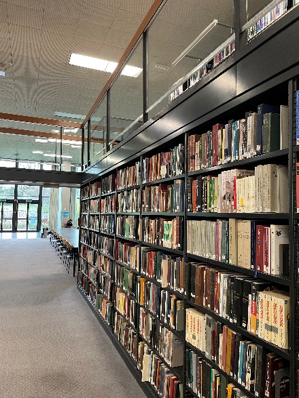
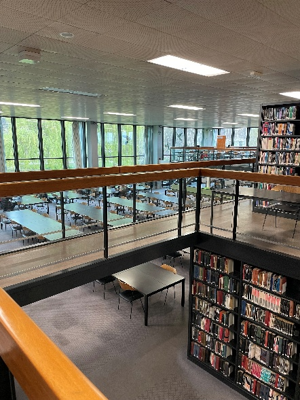
The three keynotes of the conference were not only enlightening on the local history, but also on the current topics and themes that are being researched within the postgraduate Librarianship studies at the University of Sheffield. They also addressed how the United Kingdom, and more specifically the social enterprise Shout Out UK, is dealing with the issues around mis-, dis- and malinformation by providing training and various programmes on media and political literacy.
The programme of the conference was packed to the brim with interesting sessions, and I found it difficult (if not, heartbreaking) at times to have to chose. I found myself particularly drawn to the type of sessions that addressed the needs and realities of teaching librarians and that seemed to propose concrete and helpful solutions. It was repeatedly recognized by different presenters that, as involved and passionate as we all are about the topic, our Librarianship studies seldom leave us equipped to tackle the gargantuan task of teaching, even though it is often at the core of many academic and school librarian’s position. That this dichotomy was widely verbalized and probed by fellow librarians was quite soothing, and instead of simply underlining this major issue, a lot of the presentations and workshops showcased different propositions on how to grasp the nettle. For instance, Associate professors and colleagues at the Ohio State University Libraries, Amanda Folk and Jane Hammons have created the Teaching Information Literacy Certificate Program, a completely free and virtual development curriculum that is open to both educators and librarians. Their presentation showcased the programme’s goals and structure, in addition to presenting their research into how transformative learning theory affects and alters the teaching identities of librarians who have partaken in the programme. Another example was a workshop led by Mari Kermit-Canfield and Gary R. Maixner III, respectively from Ferris State University and Indiana University, on the growth and success of a card game-based approach to library instruction. Game theory and game-based learning have become rather trendy pedagogical topics in the past years, but it does seem like it is a great match for information literacy teaching. Game in education apparently increases memory retention in participants – I daresay anyone who has ever had to teach how to use a database or a library catalogue (Grüezi Swisscovery!) will recognize the plus-value of this instantly – in addition to breathing some life into a topic that can at times be a bit dry.
Two other sessions stood out to me that were interested in research conducted in the field by librarians, one of which showcased a brilliant (although somewhat terrifying) example of evidence-based othering – a strategic appropriation and distortion of accurate scientific facts that are weaponized and sometimes dogmatized to serve a certain ideology. Kat Philipps, Joel Burkholder and Russ Hall from Penn State University have focused their study on a discourse and fact analysis of the “Fight the New Drug (FTND)” website, a non-religious and non-legislative nonprofit organisation whose mission is to raise awareness on the allegedly harmful effects of pornography on individuals and help them make an informed decision about the topic. Through a rigorous methodology, the presenters were able to demonstrate that FTND uses performative scientism and weaponized authority to transfer their moral claims into what looks like “objective” facts. The other research-related session circled back to a research programme for librarians created by the presenters Éthel Gamache, Rhiannon Jones and Helen Power, respectively librarians at Concordia University, the University of Calgary and the University of Saskatchewan. Endorsed by the Canadian Association of Professional Academic Librarians, they created this 6-week programme to support librarians in their research projects. Although we are often tasked with supporting researchers with the publication process, librarians are often ill-prepared to find themselves on the other side of the mirror. The presentation focused on the results of a recent survey regarding the programme and revealed that almost 30% of participants were not only expected but required in their current role to conduct and publish research. With over 70% of participants having never published before, Gamache, Jones and Power hit the mark perfectly.
While generative AI was obviously one of the topics in some of the sessions – one cannot escape it anymore – I found interesting and refreshing that it was not at all the main piece of conversation. And when discussed, it repeatedly happened through the lens of professional resistance. One session even challenged the inevitability of generative AI in university libraries and argued that systematic adoption is far from being the only path, underlining that it is both legitimate and necessary to adopt a reflective and ethical approach that includes the right to refuse going down the generative AI road.
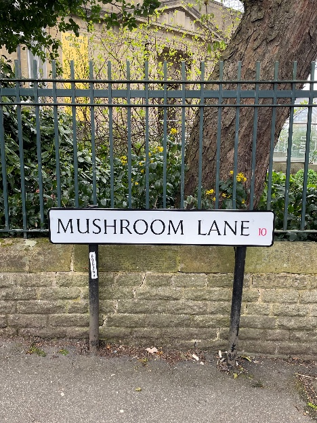
I ended my first experience of this conference on a session exploring conceptualisations of information literacy in risky leisure contexts through hobbyist mycology. As a mushroom enthusiast myself, I couldn’t help but notice the parallels between this newfound community and the topic of this last session. I am forever amazed about the sheer number of themes and topics contained within the single field of librarianship: a multiverse-worthy, or rather a mycelium of ever-growing diversity, which keeps fascinating me in and of itself.
Next year’s LILAC conference will take place 21-23 April in London. With CILIP celebrating both its 150th anniversary and the centenary of IFLA by hosting the next World Library and Information Congress in August, London will be the place to be in 2027. I, for one, look forward to be on British time again.