
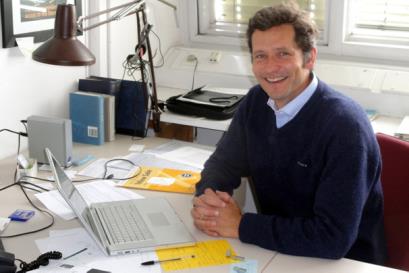
How did you become a scientific librarian?
This was really by chance. I am trained as a civil engineer, specialized in photogrammetry. As a student I was elected to be the archivist of the student association in Trondheim. Through this activity I naturally got to know many of the academic librarians at the University. When I completed my degree, a depression had struck the Norwegian economy, so it was not easy to find a job for a fresh engineer. I did not really want to leave the university, so when I was offered to join the training program for academic librarians, I accepted without any hesitation. Following the trainee program, I got a temporary position as an academic librarian at the University. One day the Head Librarian passed by my office to tell me that she had received a letter from CERN stating that they were looking for an engineer with library qualifications and encouraged me to apply. So I ended up here a few months later.
Which are your main activities right now?
I am the head of service which has for mandate the management of the Library and the Historical and Scientific Archives of CERN. But as our service is not so big, I am still involved in a variety of the classical library operations. However, a significant amount of time goes to management of staff and budgets. As a senior member of staff I also have responsibilities beyond the library itself. Ever so often I have to serve on some CERN-wide committee. What I enjoy most in my work is to assist the scientific community with their publishing issues. These activities involve a lot of negotiations with publishers and I actually believe that we have contributed to a change towards open access over the last years – not only in particle physics.
The world of scientific libraries is changing: How important are trends and innovation for your activities and how do you keep yourself updated?
It is all about change; now we are publishing open access, we retain copyright applying the CC-BY license and we are starting to publish data sets linked to plots in the articles. Only 5 years ago we did not do anything of this. I keep myself updated by following specialized email lists, exchanging email with colleagues in the field and by participating to relevant conferences in the field.
How about your network as a scientific librarian?
The network is fantastic. Librarians feel very strongly about their profession and are by default interlinked. This is a spirit that goes across all the continents. The IFLA meetings I find too big. Personally I like smaller, more specialized venues – being national or international. However, very often our issues are of an international character, so you quickly end up acting on the international arena anyway.
I have also been involved in the Library Science Talks since the beginning, but the initiative was launched by my predecessor Corrado Pettenati. Today this is run as a real tripartite operation between AILIS, The Swiss National Library and CERN – a cooperation I appreciate very much.
What do you especially like about your profession?
I find myself in a stream of information every day. In addition I have the opportunity to be in contact with many people across the world. What I enjoy most in my work is to assist the scientific community with their publishing issues. These activities involve a lot of negotiations with publishers and I actually believe that we have contributed to a change towards open access over the last years – not only in particle physics.