
RB 63, September, 2013
Patrice Landry
The MACS project has been one of the few European projects to work in providing linked data between subject heading languages. In today’s semantic web environment and semantic linked data, legacy linked data, such as MACS’s linked data, constitute valuable resources for libraries and researchers developing multilingual access.
MACS approach
The idea of providing multilingual subject access to library catalogues goes back to the early 1990s with the widespread automation of library catalogues and the development of network infrastructures. There was a new awareness that technology could expand the level of cooperation between European libraries in particular in the area of dissemination of information. European Commission programmes led to increased cooperation with European national libraries through the CENL (Conference of European National Librarians). It is in this context that in 1997 a working group, under the Cobra+ (Computerised Bibliographic Record Actions), was set up in order to discuss the issue of multilingual access across national libraries. Among many approaches discussed, the idea of establishing links between different subject heading languages (SHLs) was, for four of the participating libraries, a promising solution. These four libraries, the Swiss National Library (SNL), the Bibliothèque nationale de France (BnF), the British Library (BL) and the Deutsche Bibliothek (DDB) (now the Deutsche National-bibliothek DNB) accepted the task of defining a concept and conducting a feasibility study.
The decision to investigate interoperability between subject headings lists indicated that conditions were optimal at that time for the adoption of such an approach. By the end of the 1990s, the majority of European national libraries used and maintained SHLs developed according to national and international standards and guidelines. Many of these SHLs had been developed since the 1980s and had reached a high level of development, both quantitative and qualitative. The four libraries all used subject heading languages that were extensively used in their own countries’ libraries: SWD/RSWK (Schlagwortnormdatei / Regeln für den Schlagwortkatalog) was developed in Germany in the early part of 1980 and introduced in 1986, RAMEAU (Répertoire d’autorité-matière encyclopédique et alphabétique) was constituted in 1980 as an adaptation from the Répertoire de vedettes matières (RVM) of the Université Laval in Québec and LCSH (Library of Congress Subject Headings) widely used in Great Britain and adopted by the British Library in 1995.
The feasibility study, which was conducted from 1997 to early 1999, looked at the basis of linking headings from the three SHLs. The method of linking or “mapping” was fairly new and had not been used in the area of subject headings, nor was it supported by guidelines or standards. The linking methodology was developed by delimitating subject fields (e.g. Theatre and Sports) from which headings from the different SHLs could be analysed and matched. By working in this closed subject context, the links were established based on an analysis at the terminology level (subject heading), at the semantic level (authority record), and at the syntactic level (indexing). A match or link is considered successful when a concept represented by similar headings in the different SHLs, which are matched manually (intellectually), returns the most closely equivalent results (titles) through subject retrieval. The MACS approach can be summarized by the following principles:
- Equality of languages and SHLs: No language or SHL is used as a pivot; each language is managed autonomously outside of MACS
- Establishment of equivalences between SHLs: Headings are not translated
- Equivalence links conceived as concept clusters: Mapping is done on the basis of concepts represented by SHLs
- Consistency of results: The quality of linking is based on the retrieval of consistent and similar sets of bibliographic records from different sources
- Extendable to other SHLs: Concept clusters can be increased by almost unlimited SHLs
The MACS project was formally established in 1999 as a CENL project between the four national libraries. Since then, the project has gone through 3 phases: the prototyping phase to test the feasibility of establishing and ensuring the maintenance of links in a web-based database and searching using the links (1999-2001), development of the prototype into an operational system (2002-2005) and the move to production (operational phase) (2005-2009). As is the case for many projects, the last phase proved to be the most difficult one to complete. MACS, like many projects, succeeded in demonstrating the feasibility of a concept and applying it in a prototype. It had reached its goal by having created the infrastructure necessary for the creation of the means (links) that would allow users to conduct a multilingual subject search in the language of their choice. Only the integration of that infrastructure in the MACS partners’ institutions needed to be accomplished.
Move to production
In the Autumn of 2005, the Swiss National Library took the initiative to propose a new project strategy that called for the accomplishment of three goals: integration of the task of link creation in the work process of each institution concerned, development of a common search interface for CENL members and a permanent management structure for the long term sustainability of the MACS approach and links product. Over the next two years, exploratory work was done on defining the requirements and resources for these goals, with the priority placed on links production. Emphasis was put on adding SWD headings to links containing LCSH and RAMEAU headings. The Deutsche Nationalbibliothek and the Swiss National Library managed that task jointly.
In March 2007, work started at the Swiss National Library to create links with SWD headings. From 2007 to 2011, the subject indexing service created over 30’000 SWD links with LCSH / RAMEAU headings. In 2009, the Deutsche Nationalbibliothek received funding to hire staff to work exclusively on links creation. This work was undertaken in April 2009 at the Deutsche Nationalbibliothek in Leipzig and approximately 30’000 links were created during that year. Since then, work has continued and in August 2013, there were 62’646 SWD headings that had been linked to RAMEAU and / or with LCSH headings.
The transition to an operational phase meant that the subject headings used for linking in the MACS links database had to be kept up to date. In early 2008, the MACS Project reached agreements with the partners’ institutions for the loading of their complete list of subject headings, including monthly updates; the Deutsche Nationalbibliothek for SWD headings and the Bibliothèque nationale de France for RAMEAU headings (including RAMEAU-LCSH links already in the RAMEAU’s authorities). The loading of LCSH headings is ensured by an agreement between the Library of Congress and the CENL. With the loading of approximately 90’000 RAMEAU-LCSH links in the MACS links database organised by 60 domains based on the DDC, German-speaking indexers have many possibilities to find equivalences for SWD in their linking domains.
Another task involved the creation of a linking manual. This task was not on the MACS agenda in the early stage of the project. It became obvious as the project moved to an operational phase that a linking manual, based on published guidelines and standards was needed in order to produce coherent links in a networked environment. A manual has been drafted on the basis of the MACS principles and by using the British Standard BS 8723 Part4:2007 Structured vocabularies for information retrieval- Guide: Interoperability between vocabularies. That standard, one of the most comprehensive so far developed for linking subject headings, was an useful source for defining the scope of some of the MACS principles, notably the principle of equality of languages, the notion of source and target languages and the treatment of pre-coordinated headings.
With this manual, indexers have a clear methodological approach to undertake links creation. At the Swiss National Library, the starting point is almost always the SWD heading and one of the target languages (RAMEAU or LCSH) according to the linguistic knowledge of the indexer. He then locates a potential equivalence and in case of doubt will consult the authority record of the target language in order to determine the scope and meaning of the heading. The target’s authority record will also offer the opportunity to explore the semantic relationship and create other links in that semantic environment. The following example shows how, from the SWD heading “Altertümer” (Antiquities), other links were created using the RAMEAU authority for “Antiquités”. In that authority, the broader term “Civilisation antique” represents a concept relatively closed to “Antiquités” and is used to find a SWD equivalent. The term “Antike” seems the most appropriate but after looking up its authority, it seems that “Altertum” represent a more exact equivalence. The exact RAMEAU equivalent for “Antike” is finally determined to be “Civilisation classique”
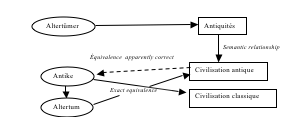
This example shows how links can be established in complex linguistic and cultural domains. These cases are often found in the area of linguistics, the arts and history where special attention is given to the scope and use of headings in the target language. In these domains, the link production is relatively low (average of 3 links per hour). In other domains, namely technical and scientific fields, link production varies from 7 to 10 links per hour.
As the project was moving forward with adding SWD headings to links, the task of developing a search interface was also on the MACS project’s agenda. The strategy adopted by the MACS partners for realising this second goal was to work with The European Library (TEL). Since TEL is a CENL service and that MACS partners are members of the CENL, it seemed important to develop a search interface that could be integrated in the TEL portal. Discussions with the TEL office started in 2006 in the context of the EDL Project, one of whose objectives was the development of multilingual capacities of the TEL portal. A first prototype was created in October 2007 and since 2009 TEL has worked in fully implementing MACS data in the TEL bibliographic services.
The MACS project has attained its goal in proposing a solution to the issue of multilingual subject access to online catalogues. This access, presently limited to three languages should be considered as a first stage in an overall solution. There are today many new possibilities for spreading this access across Europe. The use of well developed subject headings languages in most European countries and the semantic web approach in creating automatic linked data represent a solid base for new initiatives.
References
Clavel-Merrin, Genevieve (1999) “The Need for Co-Operation in Creating and Maintaining Multilingual Subject Authority Files”, 65th IFLA Council and General Conference, Meeting 155. <http://WWW.ifla.org/IV/ifla65/papers/080-155e.htm>
Freyre, Elisabeth and Naudi, Max (2001) “MACS: Subject Access Across Languages and Networks”, in Subject Retrieval in a Networked Environment: Papers Presented at an IFLA Satellite Meeting Sponsored by the IFLA Section on Classification and Indexing & IFLA Section on Information Technology, OCLC, Dublin, Ohio, USA, 14-16 August 2001. Dublin, OH: OCLC.
MacEwan, Andrew (2000) “Crossing language Barriers in Europe: Linking LCSH to Other Subject Heading Languages”, Cataloging & Classification Quarterly 29 (1/2 (2000) p. 199-207.
Landry, Patrice (2001) “The MACS Project: Multilingual Access to Subject (LCSH, RAMEAU, SWD)” International Cataloguing and Bibliographic Control 30 (3) p. 46-49.
Landry, Patrice (2004) “Multilingual Subject Access: The Linking Approach of MACS” Cataloging & Classification Quarterly 31 (3-4) p.177-191.
Landry, Patrice (2008) “The evolution of subject heading languages in Europe and their impact on subject access interoperability” in New Perspectives on Subject Indexing and Classification: Essays in Honour of Magda Heiner-Freiling .Leipzig, Frankfurt, Berlin: Deutsche Nationalbibliothek.
Landry, Patrice (2009) “Multilingualism and subject heading languages: how the MACS project will be providing multilingual subject access in Europe” Catalogue & Index 157 p. 9-11.